
Quick answer: When an engine starts cold but will not restart hot, the most likely causes are a heat-sensitive crankshaft or camshaft position sensor, weak starter affected by heat soak, fuel pressure bleeding off, failing ignition coil, vapor lock on older systems, or poor electrical connections.
Contents
Hot no-start: first identify the type of failure
The diagnosis depends on whether the engine does not crank, cranks slowly, or cranks normally but will not fire. “No crank” points toward the starter, battery cables, neutral safety switch, or ignition switch. “Cranks but no start” points toward spark, fuel, compression, or sensor signal.
| Symptom when hot | Most likely causes | First test |
|---|---|---|
| No crank or single click | Starter heat soak, weak cable, relay, battery connection | Voltage drop test |
| Slow crank | Weak battery, high resistance cable, hot starter | Battery and starter current test |
| Cranks normally, no start | Crank sensor, cam sensor, ignition coil, fuel pressure | Scan RPM signal, spark, fuel pressure |
| Starts after cooling | Heat-sensitive sensor, coil, relay, starter | Test while fault is present |
Heat-sensitive crankshaft or camshaft sensor
A failing crankshaft position sensor may work cold and lose signal when hot. Many engines will crank but not start because the computer cannot confirm engine speed. A scan tool showing no RPM during cranking is an important clue.
Starter heat soak
A hot starter can draw more current and turn slowly or not at all, especially if it is near the exhaust. Bad battery cables or grounds can make the problem worse. Voltage-drop testing while the fault is happening is more useful than guessing.
Fuel pressure problems
A weak fuel pump, leaking injector, failing pressure regulator, or check valve can cause pressure to bleed off after shutdown. When the engine is hot, vapor and low pressure can make restarting harder. A fuel pressure gauge can confirm this quickly.
Ignition coils and relays
Ignition coils, main relays, and wiring can fail under heat. If spark disappears only when the engine is hot, test the ignition signal and coil power before replacing parts.
Best diagnostic order
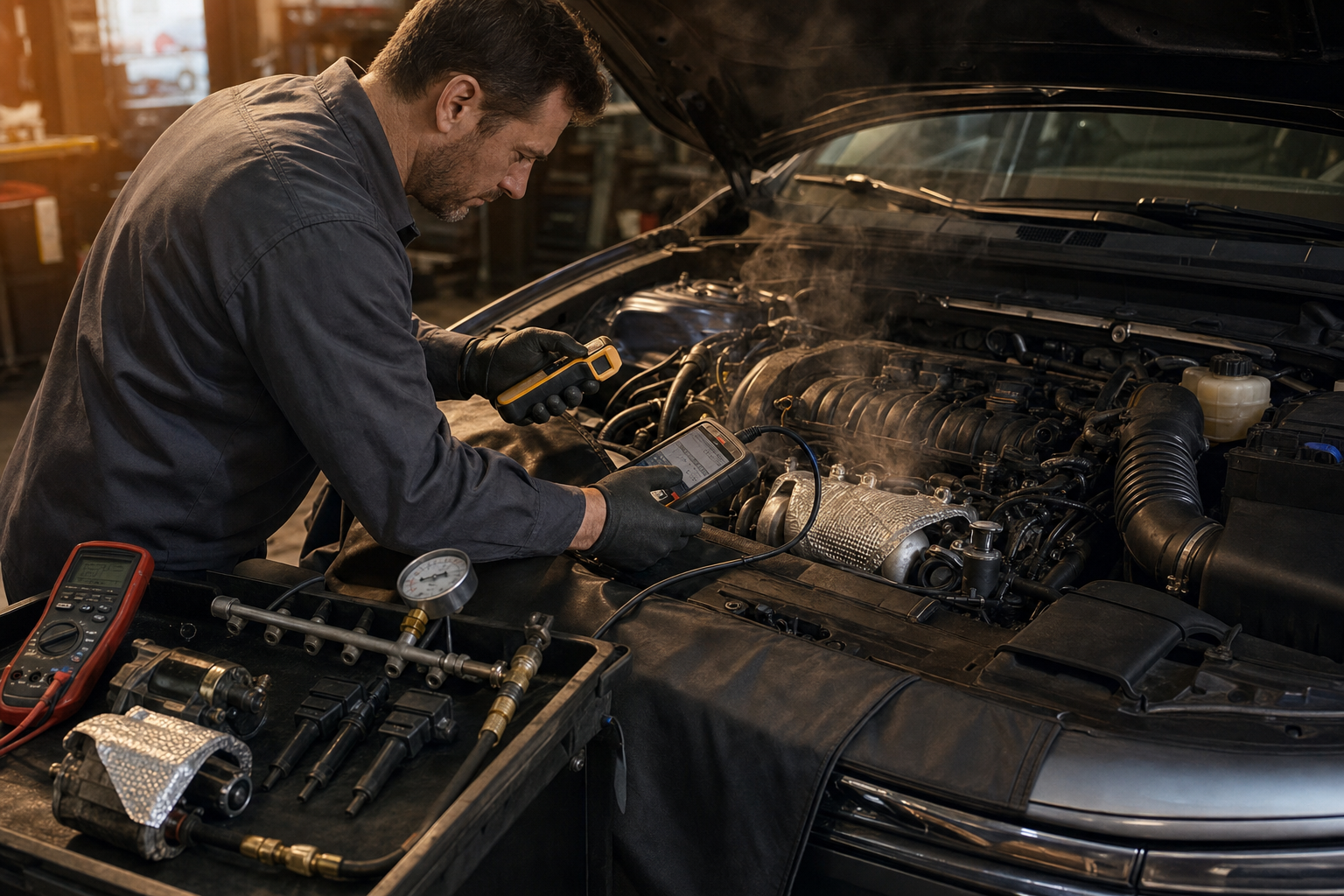
Do not replace parts randomly. Check battery voltage, crank speed, stored codes, live RPM signal, spark, injector pulse, and fuel pressure while the car is refusing to start. The best test is always performed during the actual hot no-start event.
FAQ
Why does my car start cold but not hot?
Heat can expose weak sensors, coils, starter motors, relays, and fuel-pressure problems. Parts may work when cool, then fail once engine-bay temperature rises.
Can a crankshaft sensor fail only when hot?
Yes. A failing crankshaft position sensor can lose signal when hot and work again after cooling, causing a crank-no-start condition.
Should I keep cranking the engine?
No. Long repeated cranking can overheat the starter and drain the battery. Test spark, fuel pressure, RPM signal, and stored codes instead.
Can bad fuel cause hot starting issues?
It can, especially if fuel pressure is low, the fuel pump is weak, or vapor forms in hot conditions. However, sensors and electrical faults are also very common.
Note: This guide is educational. If a symptom affects braking, steering, fuel leaks, overheating, or the car’s ability to move safely, have the vehicle inspected by a qualified mechanic before driving.
