
Contents
1. What “Emission System Problem” Means for a 2016 Honda Pilot
An “Emission System Problem” warning on a 2016 Honda Pilot does not identify one failed component. It means the vehicle’s powertrain control module, or PCM, has detected a fault that could affect engine combustion or the systems responsible for controlling exhaust or fuel-vapor emissions. The 2016 Pilot uses a 3.5-liter direct-injected V6, so the monitored systems include fuel injection, misfire detection, oxygen/air-fuel sensing, catalytic converters and evaporative-emissions equipment.
Honda’s 2016 guidance treats the malfunction-indicator lamp—the check-engine light—as an emissions-related warning. A steady light calls for diagnosis; a flashing light indicates detected engine misfire and is considerably more urgent because continued misfiring can send unburned fuel into the exhaust.
The important point is that “emission system problem” is a category of fault, not a diagnosis. Possible causes range from a relatively inexpensive EVAP valve to a fuel-injector problem, sensor fault or catalytic-converter issue.
- Steady warning: usually arrange diagnosis promptly.
- Flashing check-engine light: reduce load and stop driving when safe.
- Poor running plus a warning: treat it as a powertrain problem, not merely an emissions-inspection issue.
2. Common Symptoms and Warning Signs
Some 2016 Pilots show little besides the dashboard warning, while others develop noticeable drivability problems. The difference depends largely on which monitor triggered the fault and whether combustion itself is affected.
Common symptoms can include:
- A steady check-engine light or emissions-system message.
- Rough or uneven idle.
- Hesitation or reduced power during acceleration.
- Engine vibration or an obvious misfire.
- Hard starting or occasional stalling.
- Increased fuel consumption.
- A fuel or exhaust odor.
- Failure of an emissions inspection because the MIL is illuminated.
Injector faults, in particular, can produce misfires, hesitation and rough running. Honda’s own documentation for affected Pilots links injector problems with misfire codes P0300 through P0306 and air-fuel imbalance codes P219A and P219B.
A flashing MIL deserves special attention. Honda’s 2016 Owner’s Guide identifies flashing as an indication that cylinder misfire has been detected rather than simply another low-priority dashboard notification.
3. How OBD-II Diagnostic Trouble Codes Work
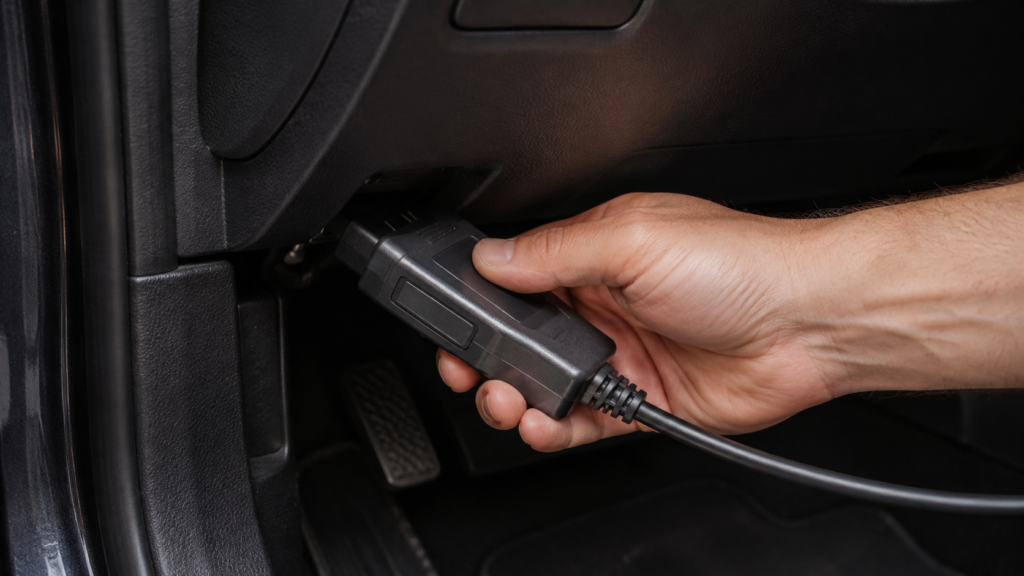
OBD-II is the standardized onboard diagnostic system used on modern vehicles. It continually monitors emissions-related functions such as fuel control and misfire detection, while other tests—including catalyst and EVAP monitoring—run when operating conditions allow. When the PCM detects a qualifying fault, it stores a diagnostic trouble code, or DTC.
A code is a starting point rather than proof that the component named in its description has failed. For example, P0420 and P0430 indicate that the computer believes catalytic-converter efficiency has fallen below the programmed threshold; they do not, by themselves, prove that a converter must be replaced.
Codes especially relevant to Honda’s documented Pilot injector campaign include:
- P0420/P0430: catalyst-system efficiency below threshold.
- P0300-P0306: random or individual-cylinder misfires.
- P219A/P219B: abnormal air-fuel variation between cylinders on a bank.
A technician also looks at freeze-frame information and live sensor data rather than simply reading the code description. Clearing codes before diagnosis can erase useful fault information and reset OBD readiness monitors, so repeatedly erasing the warning is not a substitute for finding its cause.
4. The Role of the Catalytic Converter
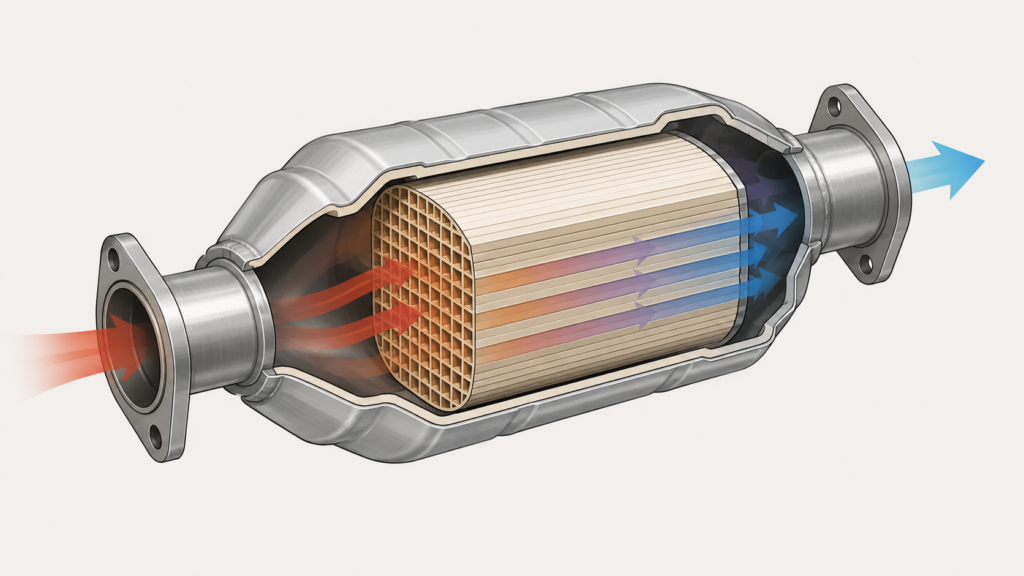
The catalytic converter is part of the exhaust after-treatment system. In a gasoline vehicle it uses catalytic materials to convert much of the carbon monoxide, unburned hydrocarbons and nitrogen oxides produced by combustion into less harmful exhaust products.
OBD-II can evaluate catalyst performance partly by examining exhaust-sensor behavior before and after the converter. A healthy converter stores and releases oxygen differently from an inefficient one, allowing the PCM to infer whether conversion efficiency has deteriorated.
Potential signs associated with a genuine converter problem include:
- P0420 or P0430 returning after other faults are eliminated.
- Reduced engine power if a converter becomes physically restricted.
- Rattling from damaged internal catalyst material.
- Excessive converter temperature following sustained misfires.
For the 2016 Pilot specifically, replacing the catalytic converter solely because P0420 or P0430 appears can be a mistake. Honda documented that PCM software could misinterpret sensor inputs as catalyst deterioration and that injector problems could accompany the same codes. Honda’s prescribed diagnostic path included software updating, cylinder air-fuel testing and, when indicated, injector replacement before condemning the catalyst.
5. EVAP System and Purge Valve Issues
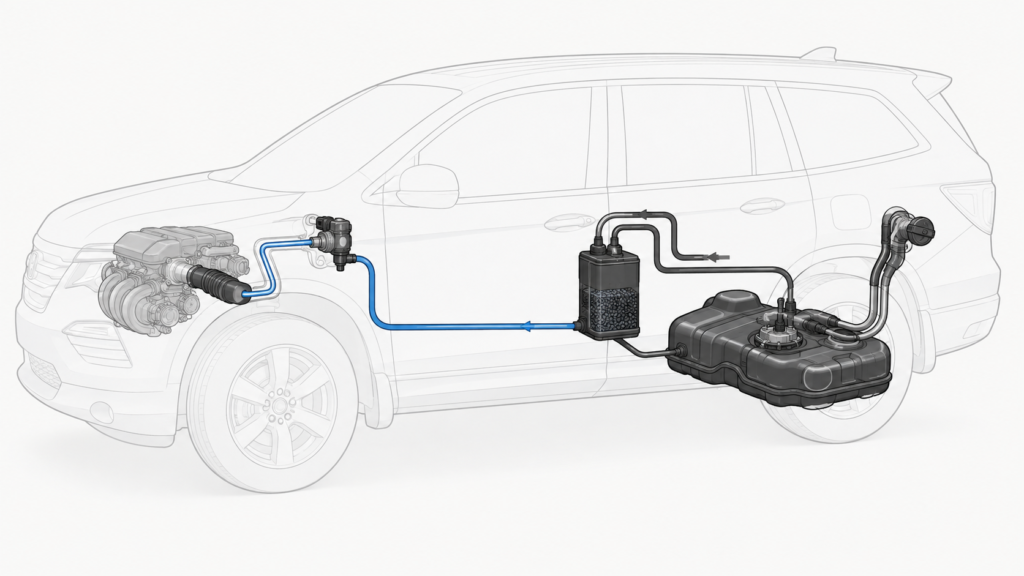
The evaporative-emissions, or EVAP, system prevents gasoline vapor from simply venting into the atmosphere. Vapors are stored in a charcoal canister and later admitted to the engine through a computer-controlled purge valve, where they are burned during normal combustion.
EVAP faults may originate from:
- A leaking hose or connection.
- A purge valve that does not open or close correctly.
- A vent valve or charcoal-canister problem.
- Fuel-tank pressure-sensor faults.
- Leakage around the filler assembly.
One Pilot-specific detail is worth noting: the 2016 model uses capless fueling, so the familiar advice to “tighten the gas cap” does not literally apply to this vehicle. A sealing problem can still occur in the filler or EVAP system, but there is no conventional screw-on cap to tighten.
A defective purge valve commonly illuminates the check-engine light without dramatically changing how the vehicle drives. Because several EVAP components can produce similar codes, proper diagnosis normally involves commanding the valve with a scan tool and, when necessary, testing the system for leaks rather than replacing parts by guesswork.
6. Oxygen (O2) Sensor Malfunctions
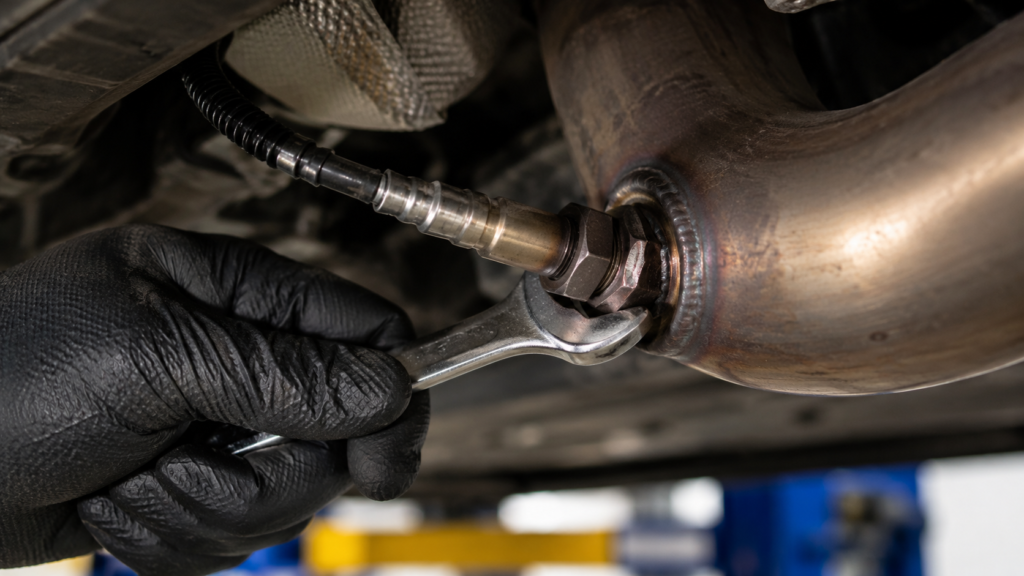
Exhaust sensors provide the PCM with information needed to control the air-fuel mixture and monitor catalyst operation. The 2016 Pilot’s emissions warranty documentation lists both heated oxygen sensors and air-fuel-ratio sensors among its emissions-related components.
A sensor problem can produce:
- A check-engine light with an oxygen-sensor or mixture-related DTC.
- Incorrect fuel-trim readings.
- Increased fuel consumption in some failure modes.
- Catalyst-monitor codes when the sensor signal is misleading.
However, a code involving an oxygen sensor does not automatically mean the sensor itself is defective. Intake leaks, exhaust leaks, wiring faults and abnormal combustion can alter sensor readings, which is why technicians evaluate live data and associated codes before replacing the sensor.
This distinction is especially important on the Pilot because Honda documented cases in which sensor information could be interpreted by the PCM as catalyst deterioration even though the repair path involved software or injectors rather than automatic catalyst replacement.
7. Reported Patterns for the 2016 Honda Pilot Specifically
There is unusually strong manufacturer documentation for one emissions-related pattern on the 2016 Pilot: fuel-injector and PCM-calibration issues. Honda stated that some injectors might not have been manufactured to specification and that debris from the high-pressure fuel pump or injector machining process could cause internal injector wear or clogging.
Honda also stated that PCM software could misinterpret certain sensor inputs as a deteriorated catalytic converter. The resulting codes could include P0420/P0430, P0300-P0306 and P219A/P219B.
Honda subsequently provided an extended warranty for eligible vehicles:
- Coverage was extended to 10 years from the original purchase date or 150,000 miles, whichever came first.
- Eligibility is VIN-specific.
- Repairs could include injector replacement and, on applicable vehicles, PCM or transmission-related software updating.
- Coverage applies to qualifying subsequent owners as well as the original owner.
This was a warranty extension/service campaign, not the same thing as a safety recall. Because 2016 vehicles are now around ten years old, eligibility in 2026 depends heavily on the exact original in-service date and mileage; owners should have Honda check the VIN rather than assuming coverage remains active.
EVAP valves, oxygen sensors and catalytic converters remain legitimate possible causes of an emissions warning, but available manufacturer documentation does not establish them as comparably distinctive 2016-Pilot failure patterns.
8. The Diagnostic Process — What a Mechanic Checks
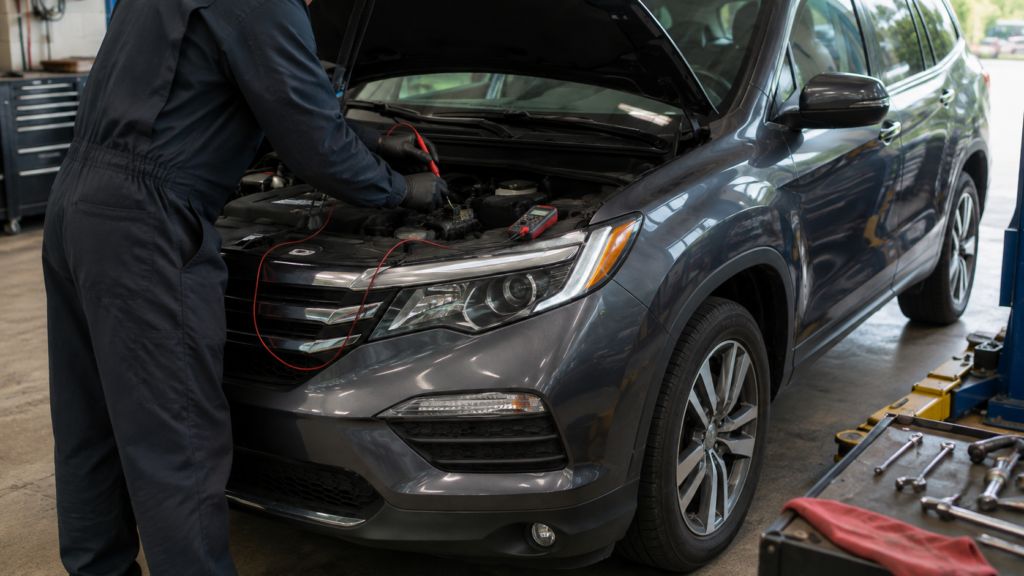
Good emissions diagnosis works from evidence outward instead of replacing the component named in the first code. A shop normally begins by interviewing the owner about when the warning appeared—after fueling, during acceleration, at cold start or during highway driving—and then performs an OBD scan.
Typical steps include:
- Retrieve current, pending and history DTCs.
- Record freeze-frame conditions before clearing anything.
- Check misfire data and fuel trims.
- Examine air-fuel and oxygen-sensor readings.
- Inspect ignition components, intake and exhaust leaks.
- Test injector balance when misfire or P219A/P219B data suggest uneven fueling.
- Command the EVAP purge system and smoke-test for leaks if necessary.
- Evaluate catalyst operation only after combustion and sensor problems have been ruled out.
For the documented Pilot injector condition, Honda’s procedure is particularly instructive. Depending on the code combination, technicians were directed to update software, perform a cylinder air-fuel test and/or replace the injectors rather than automatically install a catalytic converter.
9. Repair Options and Realistic Cost Ranges
Repair cost varies enormously because the dashboard warning can represent many different faults. U.S. estimates available in August 2026 provide useful scale rather than guaranteed quotes.
Approximate 2016 Pilot estimates are:
- Initial emissions diagnosis: roughly $60-$100.
- EVAP purge valve: approximately $130-$200.
- Fuel-injector replacement: approximately $800-$1,200.
- Oxygen-sensor replacement: roughly $680-$710 for the RepairPal estimate reviewed.
- Catalytic converter: approximately $1,800-$2,000.
Dealer pricing, regional labor rates, OEM-versus-aftermarket parts, rust and additional repairs can push the real invoice above or below these figures.
Before paying for injectors on a 2016 Pilot, owners should have Honda check the VIN against the documented warranty extension. An eligible vehicle may receive the applicable injector/software repair without the owner paying the normal retail cost.
10. Preventive Maintenance Tips
No maintenance routine can guarantee that an emissions warning will never occur, particularly where a manufacturing-related injector issue is involved. Maintenance can, however, reduce secondary problems that create misfires, poor mixture control or catalyst damage.
Useful practices include:
- Follow Honda’s scheduled oil, spark-plug and air-filter maintenance.
- Use fuel that meets Honda’s specified requirements.
- Do not continue “topping off” the fuel tank after the pump shuts off, because liquid fuel entering EVAP components can shorten their service life.
- Address misfires quickly rather than driving for weeks with the MIL illuminated.
- Repair intake, exhaust and fuel-system leaks when discovered.
- Do not routinely erase codes simply to extinguish the warning.
Maintaining correct combustion is particularly important to catalyst longevity: problems upstream of the converter should be corrected before they create a much more expensive downstream repair.
11. When to Seek Professional Help and Warranty/Emissions-Law Considerations
Professional diagnosis is appropriate when the MIL flashes, the engine shakes or loses significant power, several codes appear simultaneously, or P0420/P0430 returns after being cleared. It is also worthwhile before authorizing an expensive catalyst or injector replacement because the 2016 Pilot has a documented diagnostic history in which the apparent component was not necessarily the true cause.
For vehicles originally sold in the United States, federal emissions law provides longer coverage for certain major emissions components. EPA guidance states that specified major components—including catalytic converters, the emissions-control computer and the onboard diagnostic computer—receive federal coverage for 8 years or 80,000 miles, whichever comes first.
Honda’s own 2016 Pilot emissions-parts list similarly identifies the catalytic converters and engine/powertrain control module at 8 years/80,000 miles under its base U.S. coverage, while other emissions components have different terms and some California-emissions states receive additional coverage.
For injector-related faults, the separate Honda extension to 10 years/150,000 miles may be more important. Owners should supply the VIN to an authorized Honda dealer and ask specifically whether the vehicle remains eligible; coverage rules outside the United States differ.
12. Conclusion
An “Emission System Problem” on a 2016 Honda Pilot should be viewed as a request for diagnosis rather than a verdict that the catalytic converter, oxygen sensor or any other single component has failed. OBD-II monitors a network of systems, and several very different faults can produce similar dashboard warnings.
The 2016 Pilot does have one particularly well-documented pattern: Honda acknowledged that injector manufacturing/debris issues and PCM calibration could produce misfires, air-fuel imbalance codes and even apparent catalyst-efficiency codes. That history makes retrieving the actual DTCs—and checking Honda’s VIN-specific warranty information—especially important before expensive parts are replaced.
For an owner, the practical hierarchy is straightforward: do not ignore a flashing MIL; preserve the diagnostic codes; obtain a proper scan and testing; verify Honda campaign eligibility; and replace the component only after the evidence points to it. That approach is both less expensive and more technically sound than treating every emissions warning as a failed catalytic converter.
