
A vehicle should not be considered flat-towable merely because its transmission can be shifted into Neutral. The wheels may still rotate transmission, differential, driveshaft or transfer-case components that are not being lubricated correctly while the engine is off.
Contents
What Makes a Vehicle Eligible?
Transmission type
A manual transmission can sometimes make flat towing simpler because the gearbox can be placed in Neutral. It is not, however, a universal guarantee of towability. Some manufacturers prohibit recreational towing even with a manual transmission, while others require the manual gearbox to remain in gear because a separate transfer case is placed in Neutral.
Automatic transmissions are more configuration-dependent. In normal operation, an engine-driven or electrically controlled pump circulates transmission fluid. While a vehicle is being pulled with its engine off, internal components may continue to rotate without sufficient lubrication or cooling. Excessive heat or inadequate oil circulation can damage bearings, shafts, clutches and other internal components.
Some approved automatic, hybrid and plug-in-hybrid vehicles solve this through a manufacturer-designed Neutral Tow mode. Others require the engine to be started periodically and the transmission shifted through a prescribed sequence to circulate fluid.
Transfer-case behavior
Many manufacturer-approved four-wheel-drive trucks and SUVs have a two-speed transfer case with a true Neutral position. When the transfer case is correctly placed in Neutral, it can disconnect the transmission from the driven axles sufficiently for recreational towing.
This does not mean every 4WD or AWD vehicle is towable. A single-speed transfer case, electronically controlled AWD coupling or system without a recreational-towing mode may remain mechanically connected. Ford’s 2025 guide, for example, approves selected 4×4 trucks with two-speed transfer cases but rejects the equivalent 4×2 versions and many AWD crossovers.
Transmission-lubrication limitations
Aftermarket lubrication pumps, driveshaft disconnects and axle-disconnect devices can make some otherwise unsuitable vehicles mechanically towable. That is different from manufacturer approval.
Older MotorHome and Good Sam towing guides describe transmission-lube pumps as equipment that can circulate fluid in some automatic transmissions. The same sources caution owners to determine whether such modifications affect the vehicle warranty. Ford similarly warns that aftermarket flat-towing conversions may void warranty coverage.
Braking and towing equipment
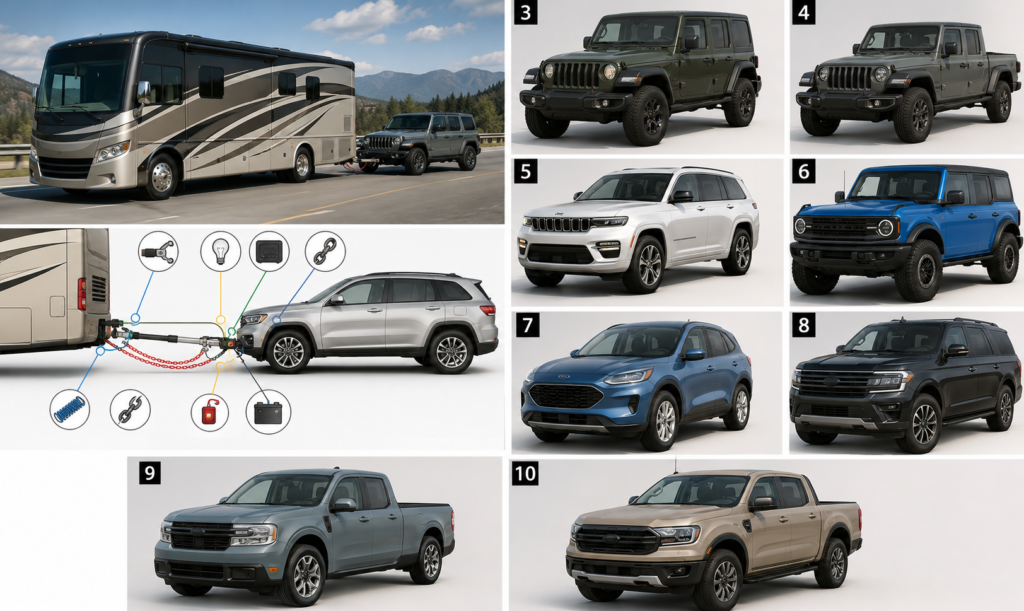
A complete installation normally includes:
- A vehicle-specific baseplate
- A tow bar rated for the vehicle’s loaded weight
- Safety cables
- Functional running, brake and turn-signal lights
- A supplemental braking system
- A breakaway device where required
- A battery-charge line when specified by the equipment or vehicle manufacturer
The motorhome’s hitch rating, gross combined weight rating and other applicable limits must also accommodate the vehicle and towing hardware. Supplemental brakes should not be omitted merely because the motorhome appears capable of stopping the additional weight.
Manufacturer approval is the deciding factor
The final authority is the owner’s manual issued for the vehicle’s exact model year, powertrain, transmission and drivetrain. A general dealer statement, online discussion or the fact that another owner tows a similar-looking vehicle is not sufficient.
Manufacturer approval can change after a redesign. A model may be towable one year and prohibited the next because its transmission, transfer case, steering system or electrical architecture changed.
Confirmed and Commonly Cited Flat-Towable Vehicles
The entries below are not an exhaustive list. The cited years indicate configurations directly supported by manufacturer material or established annual dinghy-towing guides. They do not imply that every other year of the same vehicle is approved.
SUVs and Jeeps
| Vehicle | Commonly cited model years | Drivetrain and transmission requirement | Status and caution |
|---|---|---|---|
| Jeep Wrangler | 2014; 2018–2026 generation commonly cited | Four-wheel-drive model with transfer case in Neutral. Recent manuals direct owners to place an automatic transmission in Park or a manual transmission in gear, not Neutral. | Manufacturer-approved when correctly configured. Procedures can vary by generation, including electrical and ignition steps. Do not assume a Wrangler-based model follows identical instructions. |
| Jeep Gladiator | 2024–2026 directly confirmed | Four-wheel drive; transfer case in Neutral. The cited manual specifies Park for an automatic transmission and gear—not Neutral—for a manual transmission where fitted. | Manufacturer-approved. Verify the precise transfer-case procedure and whether the vehicle requires battery or ignition management. |
| Jeep Grand Cherokee | 2014 and properly equipped 2026 models directly cited | The 2014 guide limited approval to specific 4WD systems: Quadra-Trac II on listed V6 versions and Quadra-Drive II on listed V8 versions. Jeep describes the 2026 model only as towable when “properly equipped.” | Manufacturer-approved only on eligible 4WD systems. Quadra-Trac I, 4×2 and other transfer-case combinations must not be assumed eligible. Read the manual for the exact VIN configuration. |
| Ford Bronco—not Bronco Sport | 2025 | Automatic and manual Bronco configurations are shown as eligible in Ford’s guide, using the transfer-case Neutral procedure. | Manufacturer-approved for the listed Bronco configurations. The smaller Bronco Sport is explicitly listed as not flat-towable in the same guide. |
| Ford Escape Hybrid and Escape Plug-in Hybrid | 2025 | Hybrid or plug-in-hybrid powertrain using Ford’s Neutral Tow mode. Ford lists a 70-mph maximum and requires an engine-start and gear-selection procedure at the beginning of the day and at intervals no longer than six hours. | Manufacturer-approved for the listed hybrid versions. The conventional non-hybrid 2025 Escape is not approved. Software menus and shutdown steps must be followed exactly. |
| Ford Expedition and Expedition MAX 4×4 | 2025 | Four-wheel-drive version equipped with the required two-speed transfer case, placed in recreational-towing Neutral. | Manufacturer-approved only for eligible 4×4 configurations. The 4×2 Expedition is listed as unsuitable, and optional-equipment requirements can change by trim. |
Pickup Trucks
| Vehicle | Commonly cited model years | Drivetrain and transmission requirement | Status and caution |
|---|---|---|---|
| Ford Maverick Hybrid | 2025 | Ford lists both the Maverick Hybrid and Hybrid 4×4 as eligible. Neutral Tow mode, the hybrid speed limit and periodic engine-running procedure apply. | Manufacturer-approved for the listed hybrid powertrains. The non-hybrid Maverick is listed as not eligible. Confirm whether the exact vehicle is front-wheel drive or hybrid 4×4 and follow its separate manual procedure. |
| Ford Ranger 4×4 | 2025 | Four-wheel drive with the required two-speed transfer case and recreational-towing Neutral mode. | Manufacturer-approved for eligible 4×4 models. The 4×2 Ranger is not approved, and merely selecting transmission Neutral is not the correct procedure. |
| Ford F-150 4×4 and F-150 Raptor 4×4 | 2025 | Four-wheel-drive model with an eligible two-speed transfer case and Ford’s recreational-towing feature. | Manufacturer-approved for the listed 4×4 versions. The 4×2 F-150 is listed as unsuitable. Transfer-case engagement must be verified through the vehicle’s indicators and manual procedure. |
| Ford Super Duty F-250, F-350, F-450, F-550 and F-600 4×4 | 2025 | Eligible 4×4 configuration with a two-speed transfer case placed in recreational-towing Neutral. | Manufacturer-approved for the listed 4×4 trucks. Equivalent 4×2 versions are not approved. Because these trucks can be heavy, motorhome hitch and combined-weight limits require particular attention. |
Older or Discontinued Vehicles Still Commonly Cited
| Vehicle | Commonly cited model years | Drivetrain and transmission requirement | Status and caution |
|---|---|---|---|
| Honda CR-V | 2013–2014 directly confirmed | The cited FWD and 4WD versions used an automatic transmission. Honda’s procedure required shifting through every position, holding Drive, returning to Neutral and running the engine for a specified period. A 65-mph limit applied. | Manufacturer-approved for the cited years. This does not extend approval to the redesigned 2015 or later CR-V. Battery-fuse and repeated engine-running instructions must be checked in the original manual. |
| Honda Fit | 2013 directly confirmed; other pre-redesign years are frequently cited but require separate verification | The 2013 guide lists both manual and automatic versions. The automatic required a prescribed shift and engine-running sequence, with a 65-mph towing limit. | Manufacturer-approved for the cited configuration. Do not extend this approval to later CVT-equipped Fits without documentary confirmation from that year’s manual. |
| Ford C-MAX Hybrid and C-MAX Energi | 2013 and 2018 directly confirmed; the 2013–2018 production range is commonly cited | Hybrid automatic powertrain. Ford required periodic engine operation; the 2018 guide listed a 70-mph maximum and engine operation at the start of each day and every six hours. | Manufacturer-approved for the cited years. The setup should not be confused with trailer towing—the C-MAX was approved as a dinghy but not rated by Ford to pull a trailer. |
| Ford Fusion Hybrid and Fusion Energi | 2013 and 2018 directly confirmed | Hybrid or plug-in-hybrid automatic transmission using the prescribed Neutral Tow procedure. Ford listed a 70-mph maximum and periodic engine operation. | Manufacturer-approved for the cited years. Conventional Fusion engines and transmissions had different eligibility, so a “Fusion” badge alone is not sufficient. |
| Chevrolet HHR | 2011 directly confirmed | Manual or automatic transmission placed in Neutral, steering unlocked in Accessory mode, parking brake released and the specified ignition fuse removed to protect the battery. Chevrolet imposed a 65-mph maximum. | Manufacturer-approved for the cited model year. The vehicle had to be towed forward; towing it from the rear was prohibited. Verify other HHR years independently. |
Commonly Owner-Towed but Not Manufacturer-Endorsed
Older manual-transmission Subaru Forester: Some RV owners flat tow older manual Foresters because the manual gearbox can be placed in Neutral. However, a review of Subaru guidance reported by eTrailer states that Subaru did not endorse recreational flat towing of the 1998–2023 Forester range. Automatic and CVT versions are especially unsuitable for normal-distance motorhome towing. This should therefore be classified as owner-practice towing, not manufacturer-approved towing.
Aftermarket lube-pump or driveshaft-disconnect conversions belong in the same separate category. Such equipment may make a particular vehicle mechanically towable, but it does not retroactively create factory approval.
Vehicles Commonly Not Suitable for Flat Towing
Most unapproved CVT vehicles
Continuously variable transmissions use pulley, belt or chain systems and specialized hydraulic lubrication. When the engine or required electric pumps are not operating, towing-induced rotation may occur without adequate fluid pressure or cooling.
This does not mean every CVT vehicle is automatically prohibited, but it means owners must never assume that selecting Neutral makes a CVT safe. Unless the manufacturer provides an explicit recreational-towing procedure, a dolly or full trailer is the safer method.
Many conventional automatic-transmission vehicles
An automatic transmission may rely on a pump driven by the engine’s input side. During flat towing, the wheels can rotate the output side while the pump remains stopped. The result can be poor lubrication and heat accumulation even though the transmission selector is in Neutral.
Most battery-electric vehicles
Electric vehicles frequently use permanent-magnet motors, reduction gears, electrically controlled parking mechanisms and thermal-management systems that are not intended to rotate continuously while powered down. Ford’s 2025 guide lists the Mustang Mach-E, E-Transit and F-150 Lightning as not available for four-wheel-down towing. That does not establish a rule for every EV, but it illustrates why an EV requires explicit manufacturer approval rather than assumption.
AWD crossovers without a true Neutral mode
Many AWD systems use electronically controlled clutches rather than a mechanically selectable two-speed transfer case. Raising only two wheels may also create damaging speed differences between the axles. A full trailer is often the prescribed transport method.
Two-wheel-drive versions of towable 4WD trucks
A model name may appear on a flat-tow list only because its 4WD transfer case can be disconnected. The 2WD version may have no equivalent method of isolating the rear transmission output. Ford’s 2025 Ranger, F-150, Expedition and Super Duty tables demonstrate this configuration split.
Safety and Legal Notes
Supplemental braking requirements vary by state, province and country. Some jurisdictions use a specific towed-weight threshold, while others apply stopping-distance or general safety requirements. FMCA notes that not every jurisdiction mandates a supplemental system, but recommends one because the motorhome’s brakes were designed around the coach’s own weight. RV publications similarly advise travelers to comply with the rules of every jurisdiction through which they pass.
A suitable system should apply the towed vehicle’s brakes in coordination with the motorhome. A breakaway feature can apply the toad’s brakes if it separates from the tow bar. Safety cables provide a second physical connection, while properly wired lighting communicates braking and turning to traffic behind the combination.
Before every departure:
- Confirm the tow bar and baseplate are locked.
- Cross-check safety cables and electrical connections.
- Test brake, turn-signal and running lights.
- Verify operation of the supplemental brake and breakaway switch.
- Confirm that the parking brake is released.
- Verify transmission, transfer-case and ignition positions against the manual.
- Perform a brief pull test and confirm that the toad’s front wheels steer freely.
- Stop shortly after departure to recheck the entire installation.
Flat-tow mileage may accumulate differently from odometer mileage, but tires, wheel bearings, suspension parts and portions of the driveline still experience wear while the vehicle is being pulled.
Conclusion
Flat towing can provide convenient transportation once a motorhome is parked, but the vehicle must be selected by exact configuration—not merely by model name.
The safest candidates are vehicles for which the manufacturer publishes an explicit recreational-towing procedure. Eligible models usually have either a dedicated Neutral Tow mode, a hybrid transmission designed for four-wheel-down operation or a four-wheel-drive transfer case with a true Neutral position.
Before towing any vehicle, confirm its eligibility in the owner’s manual issued for its exact model year, engine, transmission, drivetrain and trim. Follow every speed limit, distance limit, engine-running interval, fuse instruction and transfer-case procedure specified by the manufacturer. A vehicle appearing in this article must not be treated as automatically towable in every configuration or model year.
Sources & Verification
This article was developed using manufacturer recreational-towing guides, manufacturer owner’s manuals, official manufacturer support pages, annual MotorHome/Good Sam dinghy-towing guides, FMCA towing publications and established RV technical articles. Manufacturer documentation was given priority where available. Older RV guide entries were used only when they identified manufacturer-approved configurations and directed owners back to the applicable owner’s manual.
