
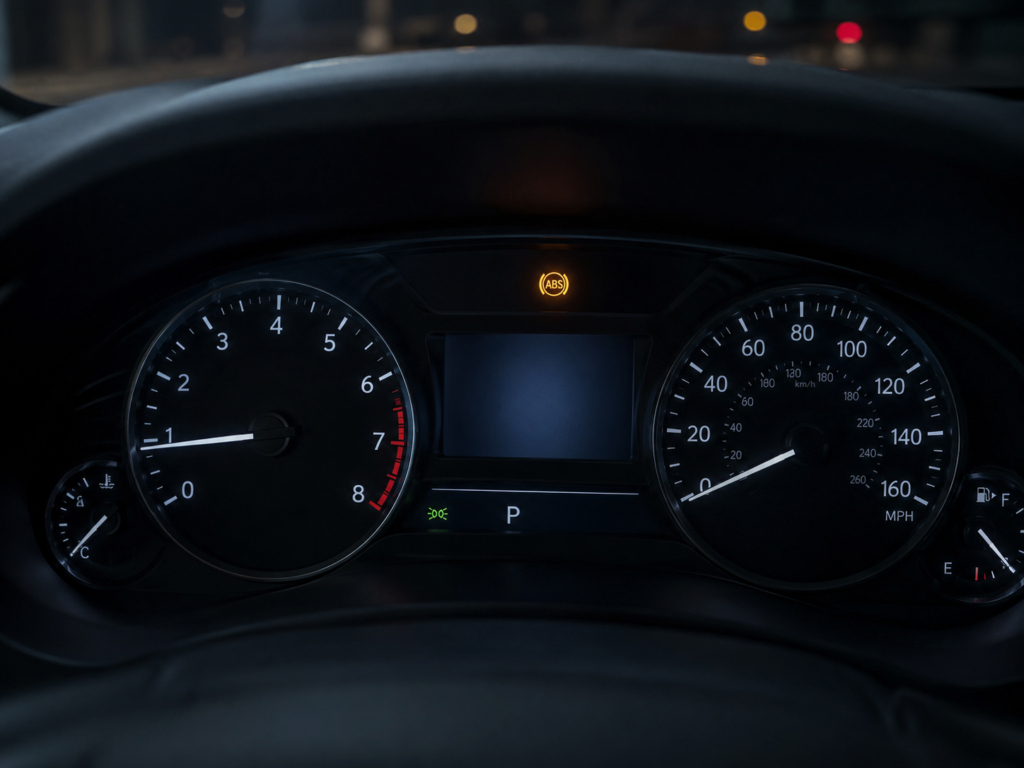
A Chevy Impala’s ABS light usually comes on because the controller has lost a reliable wheel-speed signal, although damaged wiring, a failed hub sensor, low brake fluid, a blown fuse, or an ABS module fault can also disable the system.
Contents
What the ABS Light Means
ABS stands for anti-lock braking system. During hard braking, the system monitors how quickly each wheel is rotating and briefly reduces brake pressure at any wheel that is about to lock. This helps preserve steering control, especially on wet, icy, or loose surfaces.
Your Impala’s ABS controller—often called the electronic brake control module, or EBCM—receives information from a wheel-speed sensor at each wheel. It operates valves and an electric pump inside the hydraulic control unit to adjust brake pressure.
The ABS light should illuminate briefly when the ignition is switched on. That is a normal self-test. You might also hear a short motor or clicking sound when the vehicle begins moving. If the light remains on or returns while driving, the controller has detected a fault and normally disables anti-lock operation.
According to Chevrolet’s owner information, an Impala with only the ABS light illuminated should retain conventional braking, but without anti-lock assistance. If both the ABS and red brake-system lights are on, the regular braking system may also have a problem and the vehicle needs immediate attention. (Chevrolet Impala owner’s manual)
Common Causes of an ABS Light on a Chevy Impala
Failed Wheel-Speed Sensor or Hub Bearing
A wheel-speed sensor is a small electronic device that tells the ABS controller how fast an individual wheel is turning. It reads a magnetic encoder or toothed ring rotating with the wheel.
If one sensor drops out, reports an implausible speed, or disagrees with the others, the controller cannot accurately identify a locking wheel. It stores a fault code and turns on the ABS light. Traction-control or stability-control warnings may appear at the same time because those systems use the same wheel-speed information.
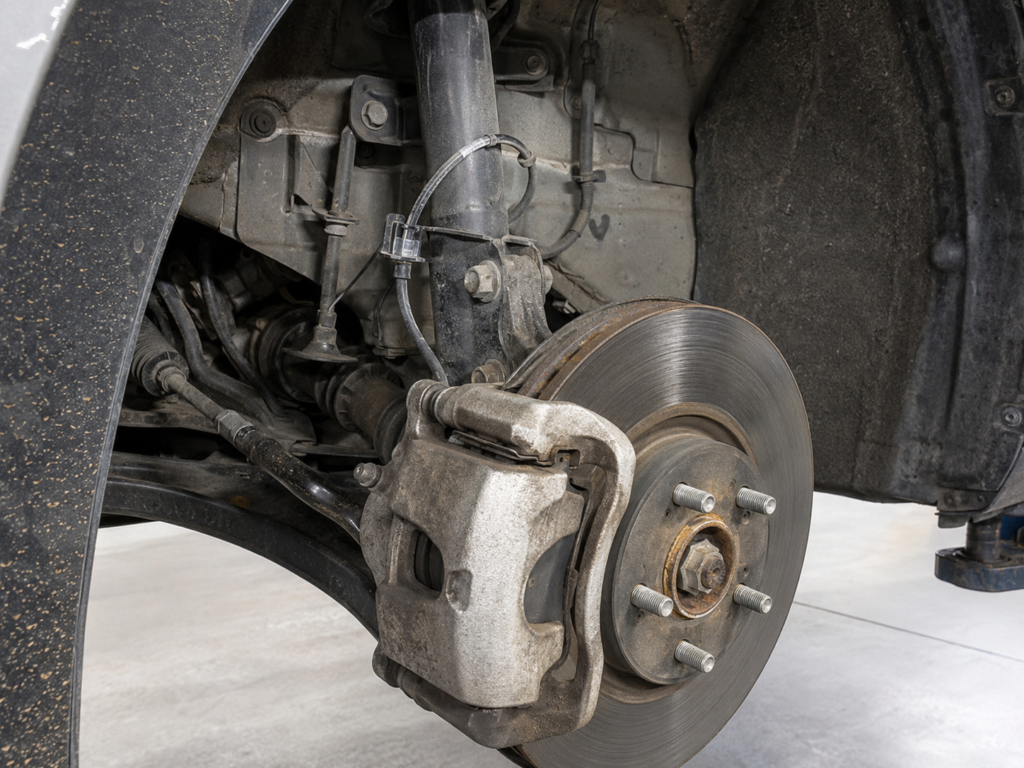
On some Impala configurations, the sensor is incorporated into the wheel-bearing hub rather than replaced separately. A failing bearing, damaged internal encoder, contamination, or excessive play can therefore create an ABS fault even when the sensor’s external wiring looks intact. Parts arrangements vary by model year and axle, so confirm the correct service procedure before ordering a complete hub.
Broken or Corroded Sensor Wiring
Wiring deserves special attention on an Impala. Sensor cables flex whenever the suspension moves and the front wheels turn. Age, road salt, water intrusion, incorrect routing, previous brake work, or contact with nearby components can break a conductor or corrode a connector.
General Motors issued service guidance for certain 2007–2013 Impalas and the 2014 Impala Limited concerning damaged front wheel-speed-sensor jumper harnesses. The condition could be easier to reproduce while turning, and the guidance warns that a simple resistance test might not reveal a wire broken inside otherwise intact insulation. (GM service information filed with NHTSA)
That bulletin does not mean every affected-looking vehicle needs a harness, nor is it proof of a recall. It does show why wiring should be inspected before replacing an expensive hub or control module.
ABS Module or Hydraulic Pump Failure
The ABS module processes sensor signals, while the attached hydraulic unit contains solenoid valves and a pump. Internal electronics, motor circuits, valve circuits, power supplies, or grounds can fail.
A module-related code does not automatically condemn the module. Low voltage, corroded grounds, network communication faults, damaged wiring, or missing sensor information can make a healthy controller appear defective. Module or pump replacement should follow circuit testing, not guesswork.
Low Brake Fluid
Low fluid more commonly illuminates the red brake warning light than the amber ABS light. However, depending on the Impala’s system and the faults detected, it may accompany ABS or stability-control warnings.
Check the brake-fluid reservoir on level ground. Fluid below the MIN mark may indicate worn brake pads, but it can also indicate a hydraulic leak. Do not simply top it off and ignore the cause. Wet brake components, a sinking pedal, or rapidly falling fluid level requires immediate professional inspection.
Blown Fuse or Power-Supply Problem
The ABS pump and controller use protected electrical circuits. A blown ABS fuse, weak connection, poor ground, damaged power wire, or charging-system voltage problem can shut the system down.
Use the fuse diagram for the exact model year because fuse locations and labels vary. Replace a blown fuse only with the specified amperage. If it blows again, the circuit may be shorted or the pump may be drawing excessive current; repeatedly installing fuses is not a repair.
ABS Light Versus the Red Brake Warning Light
The amber ABS light reports a problem with anti-lock operation. The red brake warning light can indicate an applied parking brake, low brake fluid, or a fault affecting the conventional hydraulic braking system.
If only the ABS light is on and the pedal feels normal, the Impala will generally still stop using its standard brakes. If the red brake light is also illuminated, the pedal feels soft or sinks, braking pulls severely, or fluid is leaking, stop driving and arrange a tow.
Is It Safe to Drive?
An ABS-only warning does not normally mean the brakes have disappeared, but it removes an important safety layer. During panic braking, one or more wheels may lock. A locked front wheel cannot provide normal steering control, and stopping behavior becomes less predictable on rain, snow, gravel, or ice.
Traction control and electronic stability control may also be unavailable because they rely on ABS sensors and hydraulic control. Drive only as far as reasonably necessary for diagnosis or repair, reduce speed, increase following distance, and avoid poor weather.
Do not drive if the red brake warning light is also on, the fluid is very low, the pedal is abnormal, or braking performance has changed.
Step-by-Step Diagnosis
1. Confirm Which Lights Are On
Start the engine and observe the cluster. Record whether the ABS, red brake, traction-control, or stability-control lights remain illuminated. Note whether the fault appears immediately, only after moving, while turning, or after hitting a bump.
One restart is reasonable because Chevrolet’s instructions for several Impala generations recommend stopping safely and cycling the ignition. If the light returns, the fault still needs diagnosis; repeatedly clearing or restarting does not fix it.
2. Check Fluid, Fuses, and Visible Wiring
Verify the brake-fluid level without opening the reservoir unnecessarily. Confirm that the parking brake is fully released, then inspect the relevant ABS fuses.
With the vehicle safely parked, look behind each wheel for loose connectors, stretched cables, damaged insulation, green corrosion, or wiring rubbing against the tire, suspension, or brake hose. Never crawl under a vehicle supported only by a jack.
3. Scan the ABS Controller
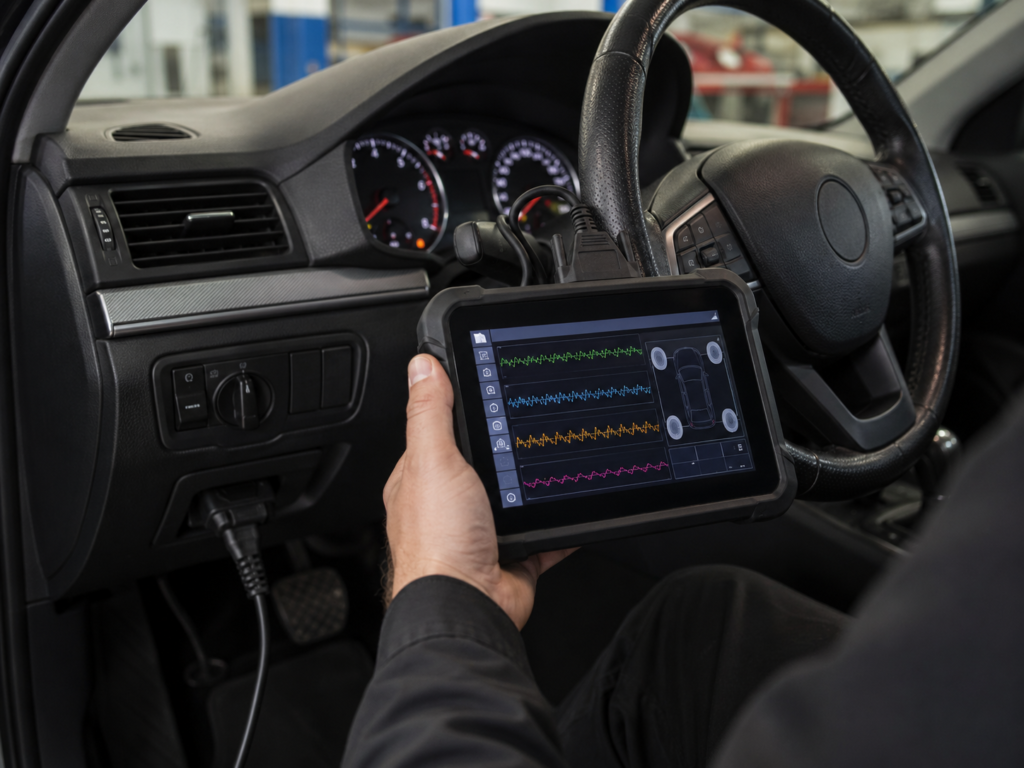
A basic engine-code reader may report only P-codes, meaning powertrain faults involving the engine or transmission. You need a scan tool capable of communicating with the ABS controller.
ABS problems commonly produce C-series diagnostic trouble codes—sometimes misheard as “C-shaped codes.” These are fault numbers beginning with the letter C, which identifies the chassis system. A code such as a wheel-sensor-circuit fault identifies the circuit the controller distrusted; it does not prove the sensor itself is bad.
Write down all codes and their status before clearing anything. Freeze-frame or failure-record data, when available, can show the conditions under which the problem occurred.
4. Compare Live Wheel-Speed Data
A capable scanner can display all four wheel speeds in real time. During a controlled low-speed test, they should rise and fall together. A sensor that stays at zero, drops out during a turn, or spikes compared with the others points toward that wheel’s sensor, hub, connector, or wiring.
Road testing should be performed by a second person operating the scanner, or by a technician. Do not watch scan data while driving.
5. Test Before Replacing Parts
Inspect connector terminal tension, power, ground, signal integrity, and harness continuity using the correct wiring diagram. Because some sensors are active electronic devices, old-fashioned resistance testing may be inconclusive. Moving the harness while monitoring live data can expose an intermittent break.
Only suspect the module or hydraulic pump after confirming battery voltage, fuses, grounds, communication wiring, sensor circuits, and wheel-speed signals.
How the Problem Is Fixed
The correct repair follows the evidence:
- Repair or replace a damaged wheel-speed-sensor harness using sealed automotive-grade connections and proper routing.
- Clean and secure corroded connectors; replace terminals that have lost tension or suffered water damage.
- Replace the sensor or hub assembly when testing confirms an internal sensor, encoder, or bearing failure.
- Correct low brake fluid by repairing the leak or servicing worn brake components—not merely by topping up the reservoir.
- Diagnose a repeatedly blown fuse before installing another.
- Replace or professionally rebuild the ABS module or hydraulic unit only after external circuits have passed testing.
After repair, clear the codes and repeat the live-data check and road test. The warning light staying off confirms that the controller no longer detects the fault; merely erasing the code before repairing the cause does not.
