
If an engine loses power when hot, something is changing as temperature rises. Heat affects air density, fuel pressure, ignition components, sensors, turbo systems, and even the ECU’s protection strategy. The result may feel like weak acceleration, hesitation, limp mode, misfires, or the engine refusing to rev.
Contents
Quick diagnosis
| Symptom when hot | Likely cause | First check |
|---|---|---|
| Power returns after cooling | Heat soak, sensor or ignition failure | Scan live data hot vs cold |
| Misfire under load | Coils, plugs, wires breaking down hot | Misfire counters and ignition inspection |
| Feels like fuel starvation | Weak pump, vapor lock, low pressure | Fuel pressure test when hot |
| Limp mode | Overheat, boost, sensor, transmission protection | Scan codes immediately |
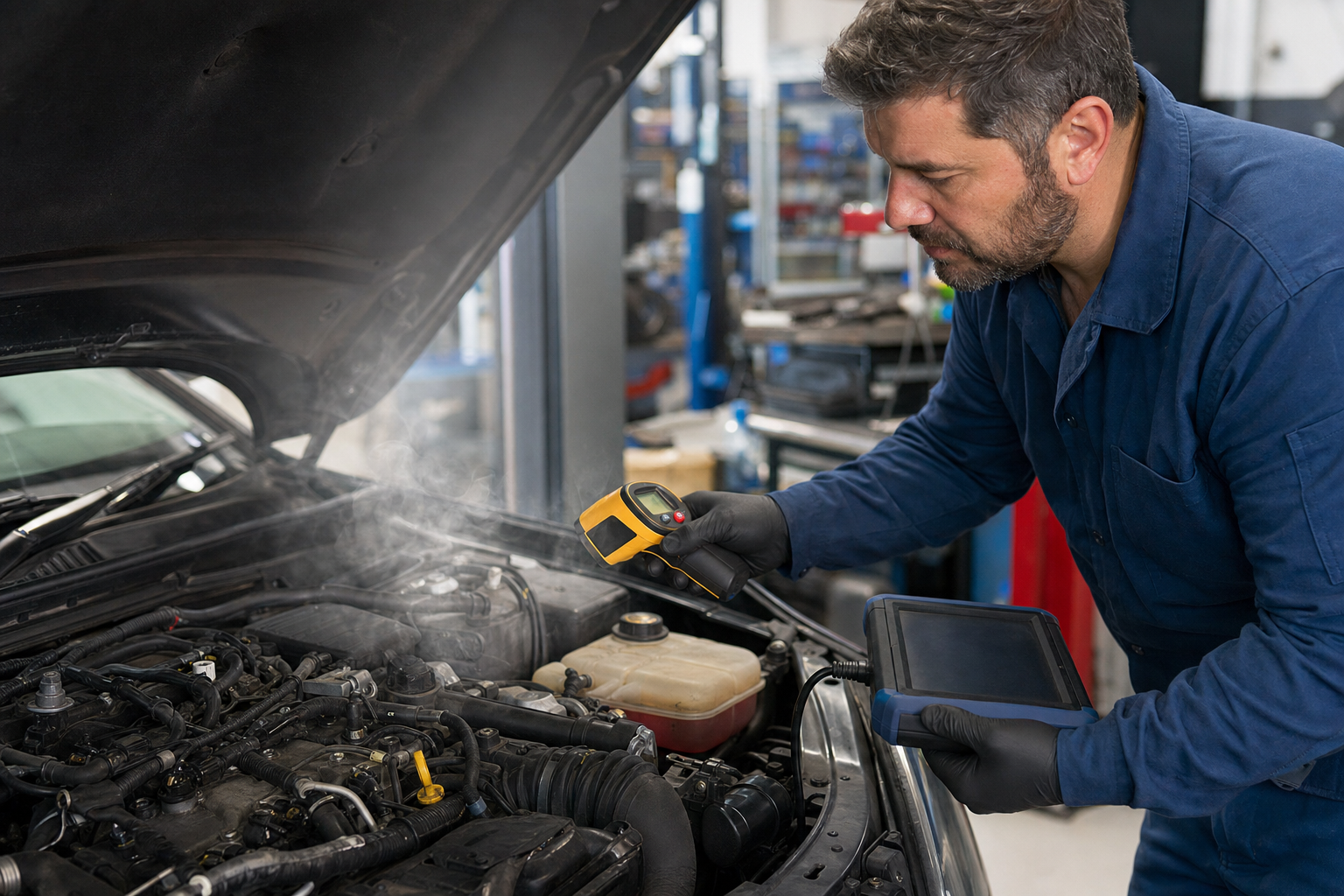
1. Heat soak
Heat soak happens when under-hood temperatures rise after driving, especially in traffic. Hot intake air is less dense, so the engine makes less power. Turbocharged engines can be especially sensitive.
2. Weak ignition components
Coils, plug wires, and ignition modules can fail when hot. They may work cold, then break down as resistance increases with temperature.
3. Low fuel pressure when hot
A weak fuel pump may lose pressure after warming up. Restricted filters, failing regulators, or vapor-related issues can also reduce fuel delivery.
4. Faulty sensors affected by heat
Crankshaft position sensors, cam sensors, MAF sensors, MAP sensors, and coolant temperature sensors can behave differently when hot. Bad readings can cause hesitation or limp mode.
5. Cooling system problems
If coolant temperature climbs too high, the ECU may reduce power to protect the engine. Check coolant level, radiator fans, thermostat, radiator condition, and water pump operation.
6. Restricted catalytic converter or exhaust
A partially clogged catalytic converter can get worse as exhaust heat rises. The engine may feel fine cold but lose power after driving.
7. Turbo or intercooler heat issues
High intake air temperature, boost leaks, or poor intercooler performance can reduce power. The ECU may reduce boost to protect the engine.
8. Transmission or drivetrain heat protection
Sometimes the engine is not the only cause. Transmission overheating or torque converter issues can make the vehicle feel underpowered when hot.
How to test it
- Scan for codes right after the power loss happens.
- Compare live data cold vs hot: coolant temp, intake air temp, fuel trims, MAF/MAP, and misfire counters.
- Check fuel pressure when the symptom is present.
- Inspect ignition parts for heat-related misfire.
- Check for exhaust restriction if power fades as the drive continues.
FAQ
Can an engine lose power just because it is hot outside?
Yes, hot air reduces power slightly. Severe power loss points to a fault.
Can a bad fuel pump fail only when hot?
Yes. A weak pump can lose pressure after it heats up.
Can overheating cause limp mode?
Yes. Many vehicles reduce power when coolant, intake air, or transmission temperature gets too high.
